
Levelling and smoothing floor compounds are designed to correct any surface irregularities within new and existing floor substrates and are available as either one or two-part products.
Easily mixed and simple to apply, they are self-smoothing and are designed to help achieve SR1 surface regularity for laying ceramic tiles or other floor coverings.
But with so many products on the market, all with different setting times, bed depths, and formulation – how do you go about selecting the right product for your needs?
Firstly it is important to understand what background you are levelling – as this can affect product selection. Typically; most self-levelling and smoothing compounds are suitable for use with cured and dry concrete, most screeds, including sand:cement, and calcium sulfate based screeds following the use of a suitable primer.
However, when levelling a substrate that may still generate movement after installation such as rigid and stable timber floors, or a screed containing underfloor heating, then fibre-reinforced products are recommended to help cope with thermal movement in the floor that occurs during changes in temperature. One such product is BAL Level Max – which has added flexibility and strength due to the presence of microfibers and polymers within its formulation.
Some products on the market can only be used over timber floors at a minimum depth of 10 mm, which can restrict the capability of the material for levelling a floor. BAL Level Max on the other hand can be used over a clean, stable and rigid timber floor at only 3 mm.
Minimum and maximum bed depths can also vary from product to product, with ranges from 1 mm to 20 mm, or 5 mm-20 mm. Generally, levelling and smoothing compounds can be applied in thicknesses of up to 30-40 mm, but often require more than one application or the addition of bulking materials is required. This means that more time is spent blending materials and mixing, but also more time waiting for layers of levelling compound to dry.
However there are some exceptions on the market. For example BAL Level Max can be applied from a minimum of 2 mm up to 80 mm (in localised areas) in one application without any additional aggregates.
This means that BAL Level Max is an all-rounder and can be used for a multitude of levelling projects. The setting-time of levelling compounds can also vary, from 1 hour to 24 hours dependent of course on the depth they are applied. BAL Level Max has consistent drying times, meaning that it can receive ceramic tiling after just four hours at 20°C even at 80 mm depth (minimum of 24 hours when applying soft-floor finishes).
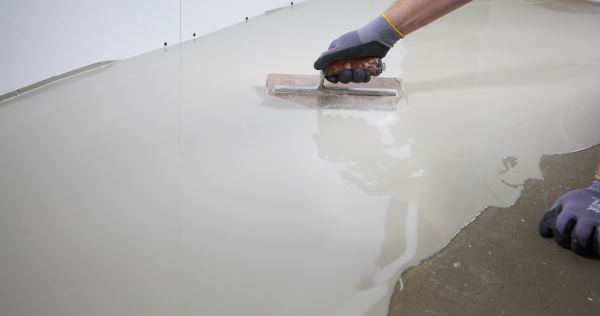
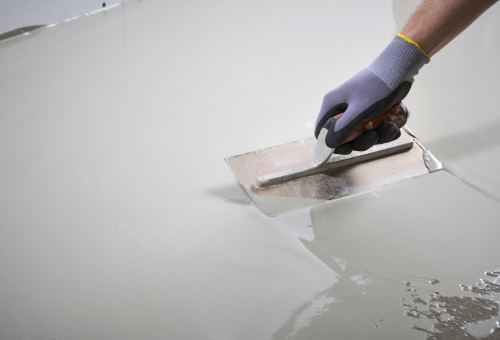
While many levelling compounds need to be spike-rolled – adding more time to the installation; BAL Level Max doesn’t require spike rolling as it has, by design, excellent self-smoothing and flow properties. This means it finds its own level when spread out, requiring only a suitable finishing trowel or long-handled blade making it easier to achieve a smooth even finish. It also maintains good wet edge properties, enabling good blending in with previous areas without any noticeable “joins”. Also BAL Level Max has good self-healing properties thus enabling any trowel marks to drop out easily.
After you’ve chosen your floor levelling compound it is crucial that the background you’re levelling is fully and correctly prepared. Firstly ensure that the surface is clean, firm, dry and free from grease, dust and any other contamination which may be considered barriers to adhesion.
Any new concrete or screed must then be left to fully cure in accordance with the relevant codes of practice before applying any products including levelling and smoothing compound. Direct-to-earth sub-floors should incorporate an effective damp proof membrane.
The majority of floor substrates will also need priming before tiling – always check with the manufacturer on the suitability of the primer to use with the background in question.
When mixing your self-levelling and smoothing compound always ensure you follow the mixing instructions and quantities – as too much water, or the wrong mixing speed could cause issues.
At BAL our Technical Advisory Service is fully equipped to provide support to contractors, architects and tilers using levelling and smoothing compounds – including NBS M40/M10/M20 specification assistance, on-site consultancy and expert technical advice.
Contact BAL Technical Advisory Service on 0845 600 1 222 or our Innovation and Technology Centre for training enquiries on 01782 591120.